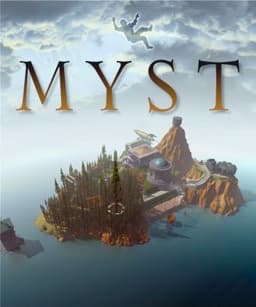
Myst
| Year | 1993 |
|---|---|
| Release platform | Mac, PC |
| Genres | puzzle, adventure |
| Developer | Cyan |
| Country | USA |
| Era | Sixteen bit, 1989 to 1995 |
| Importance |
Why it matters
Myst is assembled from pre-rendered pictures. The player stands at a point, sees one image, clicks and ends up at the next point, from which the next image opens up. There is no real-time movement at all, and that is the condition: since a frame is computed in advance and can take as long as it needs, it can afford light and surfaces that no engine of the time could manage. The Macintosh version was built in HyperCard, an environment of linked cards, which describes the structure of the game itself fairly accurately.
The way of showing things set the rules too. The player has two actions, look and click, so every puzzle has to be a mechanism that can be read from a still frame: levers, gears, switches, sound signals. There are no enemies, no timers, you can't die along the way, and the player sets the pace. There are no explanations on screen either; you have to work things out from notes in books and from the look of the devices themselves. The images and sound took up so much space that publishing the game made sense only on a CD, and an island without a single enemy became an argument for buying a CD-ROM drive.
Watch it played
Facts
- The game consists of pre-rendered frames, and you move between points with a click.
- The Macintosh version was built in HyperCard, an environment of linked cards.
- There are no enemies or timers, and you can't die along the way.
- The puzzles are built as mechanisms and are worked out by look and sound, without explanations on screen.
- The volume of images and sound made the CD the only sensible medium.