Boulder Dash
| Year | 1984 |
|---|---|
| Release platform | Atari 8-bit |
| Genres | puzzle, arcade |
| Era | Eight bit, 1983 to 1991 |
| Importance |
Why it matters
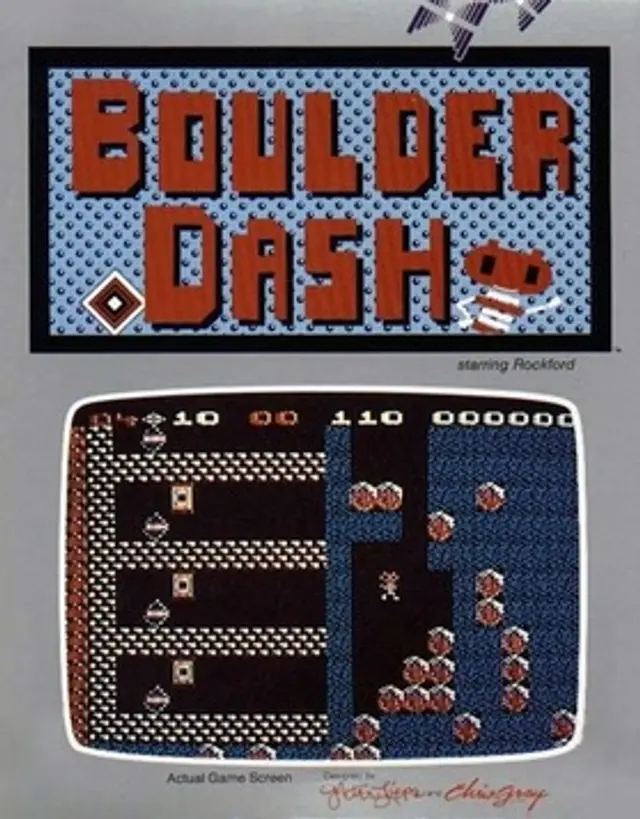
In Boulder Dash, movement changes the problem itself. Rockford passes through dirt and collects diamonds, but removing a square of earth can release a rock above it. A moment later, a safe corridor becomes a collapsing passage. You cannot separate the route from its consequences: every step moves the character and reshapes the cave at the same time.
Rocks and diamonds follow consistent rules for falling and rolling. You can study these rules, use them against enemies and account for them when preparing a passage. Each level requires a quota of diamonds and a trip to the exit within a time limit. A good solution combines sequence with execution: seeing a path is not enough, because it must remain usable after the rocks move.
Peter Liepa and Chris Gray created the game, released by First Star Software for Atari 8-bit computers in 1984. Their recollections emphasize experiments with the behavior of dirt and rocks. This provides a useful key to Boulder Dash's design: tension comes from a small set of interacting rules rather than a constant supply of exceptions.
Facts
- The original was released on Atari 8-bit computers in 1984.
- The game was created by Peter Liepa and Chris Gray.
- Removing dirt can set the rocks it supported in motion.
- The exit becomes available after the required number of diamonds is collected.