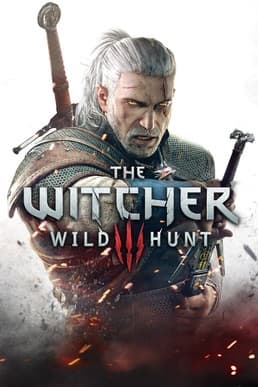
The Witcher 3: Wild Hunt
| Year | 2015 |
|---|---|
| Release platform | PC |
| Genres | RPG |
| Developer | CD Projekt Red |
| Country | Poland |
| Era | Today, 2010 to 2026 |
| Importance |
Why it matters
The Witcher 3 draws on Andrzej Sapkowski's book cycle, and that sets the tone: the witcher works for hire, and clients rarely tell the whole truth. The open world here serves as a stage for quests, and traces at the scene are highlighted by witcher senses.
A side contract is built on the same scheme as a story quest: examining the scene with witcher senses, talking to people, reconstructing what happened and a decision with no obviously right option. The consequences are often delayed and surface hours later, in someone else's scene, with no direct pointer to the cause. Gwent, a card game inside the game that was later released on its own, runs as a separate layer. The campaign was continued by two expansions, Hearts of Stone and Blood and Wine; the second adds a separate region with its own map. The game came out on PC, PlayStation 4 and Xbox One at the same time. It all runs on the studio's own engine, REDengine 3.
Watch it played
Facts
- The story is based on Andrzej Sapkowski's book cycle.
- Investigations are carried out through the witcher senses mode, which highlights traces.
- Side quests are built like story quests and often end in an ambiguous choice.
- Inside the game there is a card game, Gwent, later released as a separate product.
- Two major expansions were released for the game: Hearts of Stone and Blood and Wine.