Donkey Kong
| Year | 1981 |
|---|---|
| Release platform | Arcade |
| Genres | platformer |
| Developer | Nintendo |
| Country | Japan |
| Era | Arcades, 1971 to 1983 |
| Importance |
Why it matters
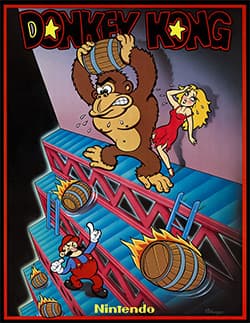
The machine was made to recover money already spent: unsold Radar Scope cabinets were sitting in America, and the new board was installed in them in place of the old one. The decisions are therefore economical. There is one screen and it doesn't scroll, there are only four levels, and after the last one they repeat with increased difficulty. All the content fits into four pictures, and the player sees each one in full from the first second.
Arcades at the time were about shooting, and here there is nothing to shoot with: the only permanent move is the jump, which is also the way to dodge, the way to score points and the way to make a mistake. The hammer appears briefly and changes the conditions: it smashes barrels, but with the hammer in hand you can neither jump nor grab a ladder, so the power-up immediately takes away freedom of movement. Between levels there are short cutscenes explaining who is carrying whom and where, so the machine reads as a coherent story. From this assembly, where the goal is at the top, obstacles fall from above, and the player deals with them by jumping, grew the platformer genre, and Nintendo returned to this assembly in its own games of the following decade.
Watch it played
Facts
- The boards were made to convert unsold Radar Scope machines sitting in a warehouse in America.
- There are four levels, and after the last one they repeat with increased difficulty.
- With the hammer in hand you can neither jump nor climb a ladder.
- The machine was designed by Shigeru Miyamoto, who was working at the company as an artist at the time.
- Universal brought a claim against Nintendo over the similarity to King Kong, and the court decided the case in Nintendo's favor.