Space Invaders
| Year | 1978 |
|---|---|
| Release platform | Arcade |
| Genres | shooter |
| Developer | Taito |
| Country | Japan |
| Era | Arcades, 1971 to 1983 |
| Importance |
Why it matters
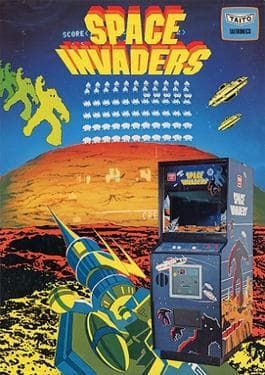
The Taito machine is built around a simple calculation: the enemies march in formation from top to bottom, the player moves along the bottom edge of the screen and hides behind four shields. The shields are destroyed by hits from both sides, so the player's own fire gradually strips away their protection. There is nowhere to retreat, the field doesn't scroll, and the whole game comes down to one question: can the player take the formation apart before it reaches the ground.
The aliens speeding up toward the end of a wave came about as a consequence of hardware limits: the fewer objects were left on screen, the faster the machine could process them. The effect was left unfixed, and it became the main source of tension. Something else stuck too: the best result shown on screen turned a casual game into a competition with yourself and with the previous visitor. After Space Invaders, the arcade machine became a device people came back to for the score.
Watch it played
Facts
- The machine is built on an Intel 8080 processor.
- The aliens speed up because with fewer objects the machine can draw a frame faster.
- The color on screen comes from strips of colored film laid over a monochrome picture tube.
- The four shields are also destroyed by the player's own shots.
- The waves follow one another with no final level; the game ends only when all lives are lost.