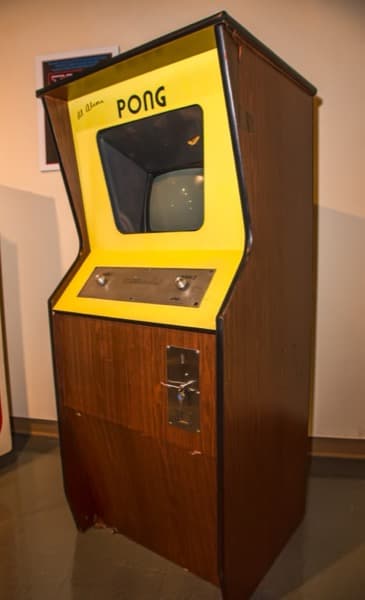
Pong
| Year | 1972 |
|---|---|
| Release platform | Arcade |
| Genres | sports, arcade |
| Developer | Atari |
| Country | USA |
| Era | Arcades, 1971 to 1983 |
| Importance |
Why it matters
Pong is built on discrete logic: the machine has no processor and no program in the usual sense, and the behavior of the ball is set by a circuit of chips. On the screen there are two vertical lines, a dot and the score, and the rules fit in a single line on the cabinet. That brevity solved a problem earlier machines had failed at: a bar patron doesn't need to read anything, they understand what is going on within a couple of seconds.
The bounce here is not strictly mirrored. The paddle is divided into segments, and the angle depends on which of them receives the ball, so the return becomes a controlled action. Speed rises over the course of a rally. Out of this grows the reason people kept coming back to the machine: a short game, clear at first glance, but with room for skill. Pong's commercial result showed that a video game works as equipment for public places, and dozens of companies almost immediately started producing similar machines.
Watch it played
Facts
- The machine runs on discrete logic; it has no microprocessor and no program code.
- The paddle is divided into segments, and the bounce angle depends on where the ball touches it.
- The prototype for testing demand was placed in a bar in California, not in an arcade.
- Magnavox brought patent claims against Atari over the similarity to the tennis game on the Odyssey console.
- The home version, Home Pong, came out in 1975 and was sold through the Sears retail chain.