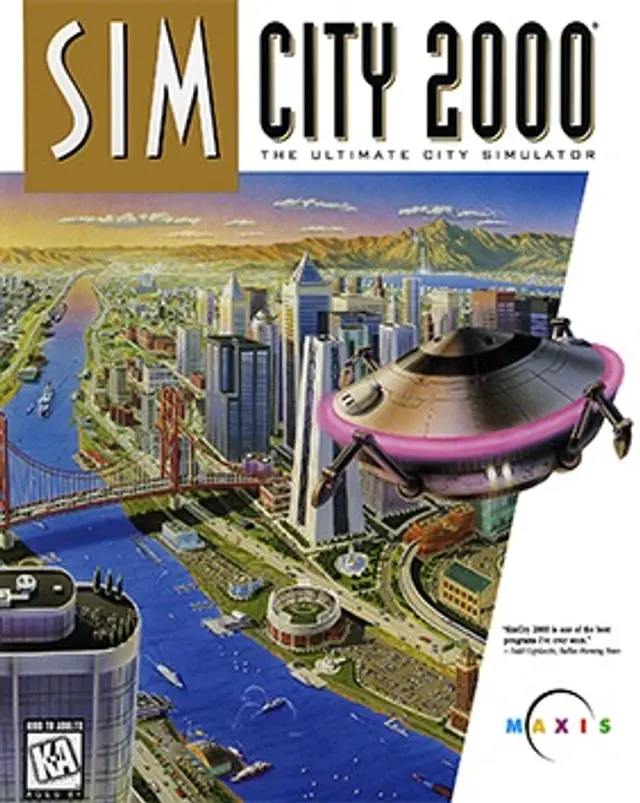
SimCity 2000
| Year | 1993 |
|---|---|
| Release platform | Mac, PC |
| Genres | simulation, strategy |
| Developer | Maxis |
| Country | USA |
| Era | Sixteen bit, 1989 to 1995 |
| Importance |
Why it matters
SimCity 2000 makes the city a layered problem. Residential, commercial and industrial zones, roads and services occupy the surface, while water pipes and subways run underground. Terrain adds another constraint: a convenient line on a flat plan can be expensive to build. The isometric view helps you examine the city as a connected structure with hidden parts.
You manage the conditions for development. You designate zones, provide infrastructure and distribute the budget, while buildings and population respond to those decisions. A new road does not exhaust the transport problem, a power station needs money, and expanding districts puts more pressure on services. Growth becomes a feedback loop: a successful decision creates the next problem.
Maxis released the game in 1993, developing ideas from the original SimCity. It rewards observing how a local change affects the whole system: comparing maps, reading indicators and checking results after time has passed. The model nevertheless remains a set of authored assumptions about urban life. Its historical value lies in making the relationships between infrastructure, budgets and everyday surroundings a subject for play.
Facts
- Fred Haslam and Will Wright designed the game at Maxis.
- The underground view displays water pipes and subway lines.
- Land elevation affects how the city is laid out.
- Schools, hospitals and other services require funding from the budget.