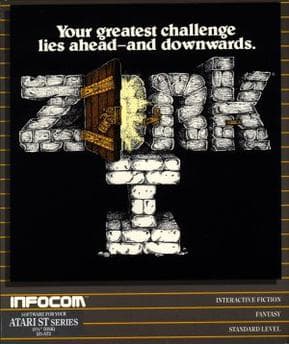
Zork
| Year | 1980 |
|---|---|
| Release platform | Apple II, PC |
| Genres | adventure |
| Developer | Infocom |
| Country | USA |
| Era | Arcades, 1971 to 1983 |
| Importance |
Why it matters
Zork was written on a PDP-10 mainframe at the Massachusetts Institute of Technology and at first existed as an in-house amusement. Moving it to a home computer in one piece didn't work: that much material wouldn't fit in a microcomputer's memory. The text was cut into three parts, and each came out as a separate release with its own geography and its own set of puzzles. Here the memory limit directly determined the shape of the release.
So that the same game could run on machines incompatible with one another, Infocom compiled it into code for a virtual machine invented inside the company. Only a small interpreter had to be ported to a new platform, and the text adventure became a product released on a dozen different computers at once. Command parsing is more thorough than in its predecessors: the parser accepts prepositions and several objects in one phrase, where earlier games understood only a verb and noun pair. The player addresses the world in words and spends half the time finding out which words that world understands. The resources work toward the same tension. The lantern uses up its charge, in the dark the character dies, and a thief roams the dungeon carrying off treasures already collected, so the order of the route has to be planned in advance.
Watch it played
Facts
- The game started on a PDP-10 mainframe at MIT and was not intended for sale.
- For home computers the text was cut into three parts, released as separate titles.
- Infocom compiled its games for its own virtual machine, so only the interpreter had to be ported to a new platform.
- The parser handles prepositions and several objects in one command.
- The lantern uses up its charge, and in an unlit room the character dies.