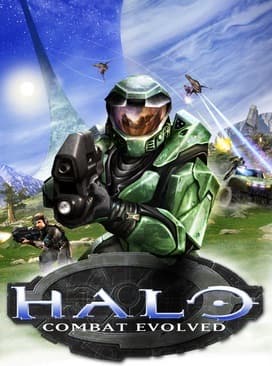
Halo: Combat Evolved
| Year | 2001 |
|---|---|
| Release platform | Xbox |
| Genres | shooter |
| Developer | Bungie |
| Country | USA |
| Era | The 2000s, 2000 to 2009 |
| Importance |
Why it matters
Halo was made as a shooter for a gamepad, and both of its main decisions grew out of that limitation. You can carry only two guns, so switching weapons becomes a separate act: picking up a new one means dropping the old one right there. Cycling through a dozen keys, impossible on a console, falls away by itself. The energy shield drains under fire and recharges on its own if you get out of the line of fire and wait, so a fight breaks down into approaches and retreats, and hunting for health packs in corners stops setting the pace.
Added to this is a control layout that almost every console shooter later copied: the left stick moves the hero, the right one looks, shooting and the grenade are given to the triggers, and the melee strike has its own button. The grenade and the strike are always available and don't take up a weapon slot, so three actions alternate at once in a fight. Enemies pull back under fire, flank and scatter when they lose their commander, and vehicles carry several people, with the player and a partner sharing the driver's seat and the gun. The campaign can be played by two people on one screen. The project didn't start out for a console and was shown as a computer game, but Microsoft bought the studio, and Halo came out alongside the Xbox as the system's launch title.
Watch it played
Facts
- You can carry only two guns; a third has to be left on the ground.
- The energy shield drains under fire and recharges on its own if you get out of the fight.
- The grenade and the melee strike are always available and don't take up a weapon slot.
- The project started as a computer game; it became an Xbox launch title after Microsoft bought the studio.
- The campaign can be played by two people on one screen.