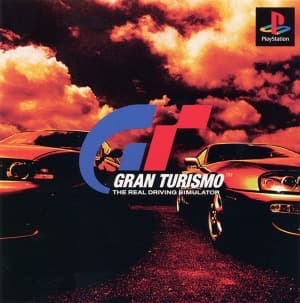
Gran Turismo
| Year | 1997 |
|---|---|
| Release platform | PlayStation |
| Genres | racing, simulation |
| Developer | Polyphony Digital |
| Country | Japan |
| Era | Disc and 3D, 1995 to 2000 |
| Importance |
Why it matters
Polyphony Digital built its racing game out of production cars licensed from the manufacturers, and most of the races are run in ordinary road cars. A car is bought with earned money, it has mass, power and a drivetrain, and purchased parts change its behavior: gear ratios, suspension stiffness, tires and camber are tuned by hand, and every setting is checked against the stopwatch on the track.
Access to competitions is opened by license tests: short exercises in braking, corner entry and acceleration that have to be passed against the clock. The exam here teaches you to brake before the corner, because the grip calculation punishes the reverse order. Racing stops being an arcade run and becomes long work with a single car: earn, buy, tune, drive a cleaner lap than before. Development was led by Kazunori Yamauchi, and the order set here, licensed cars plus manual tuning, is what the series kept from then on.
Watch it played
Facts
- The cars in the game are production models licensed from the manufacturers.
- Access to competitions is opened by license tests that have to be passed against the clock.
- Purchased parts change how the car behaves, and gear ratios and suspension are tuned by hand.
- The arcade mode and the career mode are kept separate and run by different rules.
- Development was led by Kazunori Yamauchi.