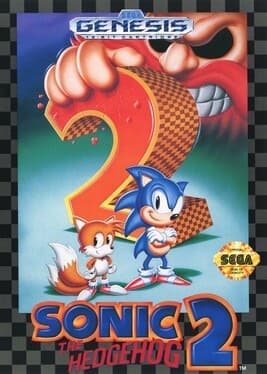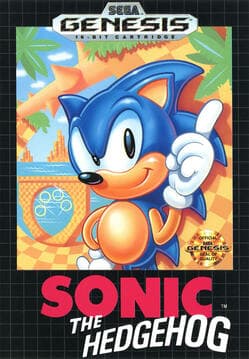
Sonic the Hedgehog
| Year | 1991 |
|---|---|
| Release platform | Sega Mega Drive |
| Genres | platformer |
| Developer | Sonic Team |
| Country | Japan |
| Era | Sixteen bit, 1989 to 1995 |
| Importance |
Why it matters
Sega was looking for a character who could hold attention on the shop shelf next to Nintendo, and got a hero whose main trait is speed. The levels are built like tracks with slopes, loops and ramps: the engine constantly recalculates the angle of the surface under the character's feet, so a descent speeds you up and a climb slows you down. The controls come down to running and jumping; all the difficulty is moved into reading the terrain. The space is also divided into tiers: the upper path goes to those who keep up the pace, the lower one is taken more carefully and takes longer.
Rings work in place of a health bar. As long as the hedgehog has at least one ring, a hit only scatters what has been collected across the screen, and there is a second to pick some of it back up. That decision removes the fear of speed: mistakes are paid for in rings. Sega started bundling the console with this cartridge, and it gained a face recognizable without explanation.
Watch it played
Facts
- The character's speed depends on the angle of the surface: a descent speeds you up, a climb slows you down.
- Rings replace the health bar; when you are hit they scatter across the screen, and some can be picked back up.
- In North America Sega started putting the cartridge in the box with the console instead of Altered Beast.
- The special stage with the rotating maze is entered with fifty rings collected by the end of an act.
- The music was written by Masato Nakamura, bassist of the band Dreams Come True.