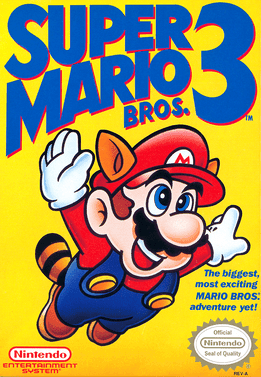
Super Mario Bros. 3
| Year | 1988 |
|---|---|
| Release platform | NES |
| Genres | platformer |
| Developer | Nintendo |
| Country | Japan |
| Era | Eight bit, 1983 to 1991 |
| Importance |
Why it matters
The third installment replaced the straight chain of levels with a world map. On the map you can see what lies ahead, some levels can be bypassed, and items you find go into a stockpile and are used before entering a level. The playthrough stopped being a single line: there was now a choice of where to spend what you had saved up and what to skip, and there was a reason to return to squares already passed.
The suits define different sets of moves. The raccoon suit lets you take off, but only with a full run-up meter, which fills only on a long straight, so flight has to be prepared, and the levels are built with that condition in mind. The frog suit changes the controls underwater, the hammer suit gives protection from fire, so each suit is a separate way of reading the same obstacle. The presentation states the rules outright: a curtain rises at the start, the scenery hangs on visible fixtures, the exits lead offstage. The game doesn't pretend to be a world, it presents itself as a stage production, and that removes the question of why the layout of the levels is subordinated to the player's convenience.
Watch it played
Facts
- The levels are laid out on a world map, and some of them can be bypassed.
- Items you find go into a stockpile and are used on the map before entering a level.
- Flying in the raccoon suit requires a full run-up meter, which fills only on a long straight.
- The game is presented as a stage play: a curtain rises at the start, and the scenery hangs on visible fixtures.
- In America the cartridge came out later than the Japanese release and was shown in advance in a feature film.