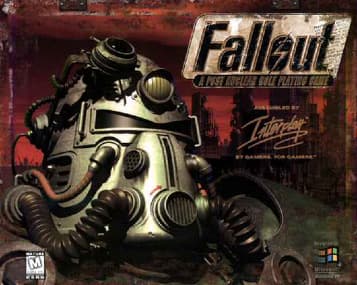
Fallout
| Year | 1997 |
|---|---|
| Release platform | PC |
| Genres | RPG |
| Developer | Interplay |
| Country | USA |
| Era | Disc and 3D, 1995 to 2000 |
| Importance |
Why it matters
Interplay assembled the character from exposed parts: seven primary statistics, a set of skills and traits, each of which has both a plus and a minus. The numbers aren't hidden; they are visible to the player and work the same way in combat and in conversation, so low intelligence changes the available dialogue lines, and high agility changes the number of actions per turn. Combat is turn-based and counted in action points: a step, a shot and a reload all draw on one shared pool. You can take aimed shots at body parts, and each part has its own hit chance and its own consequences.
The consequences here are real. The world is open, the starting quest has a deadline, and time in the world passes regardless of what the player is doing. Most quests have several outcomes, including refusing to fight: the main antagonist can be dealt with through conversation. The ending is put together from separate reports on the fate of each settlement, and they depend on what the player did or didn't do there. Out of this construction grew the recognizable Western RPG school: the game doesn't check whether you played it right, it tells you what came of it in the end.
Watch it played
Facts
- The character is defined by seven primary statistics, skills and traits that each have a plus and a minus.
- Combat is turn-based, and each turn action points are spent on movement, shots and items.
- Shots can be aimed at body parts, and each part has its own hit chance.
- The starting quest has a deadline, and time in the world passes independently of the player.
- The ending is put together from reports on the fate of each settlement and depends on the player's decisions.