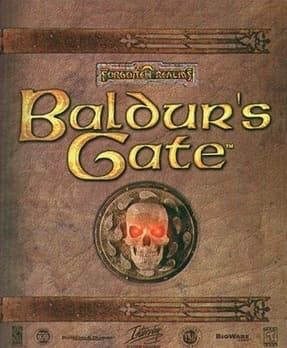
Baldur's Gate
| Year | 1998 |
|---|---|
| Release platform | PC |
| Genres | RPG |
| Developer | BioWare |
| Country | Canada |
| Era | Disc and 3D, 1995 to 2000 |
| Importance |
Why it matters
BioWare brought the tabletop rules of Advanced Dungeons & Dragons to the computer almost without simplification: armor class, dice rolls, saving throws, spells that have to be prepared in advance. In essence the rules stayed turn-based, but combat runs in real time, and the contradiction is resolved by the pause. The action can be stopped at any moment, orders are given to the whole party during the pause, and when the pause is lifted everything is carried out at once. The pause is configurable: it can be set to trigger automatically on events, from an enemy appearing to a companion dying.
The result is a format that holds both tactics and pace: a hard fight is taken apart step by step, and the stretches between fights don't drag. The party holds up to six characters, the companions have their own views and conditions, and some of them leave if the player's behavior doesn't suit them. The maps are pre-drawn in isometric view, and the characters are rendered on top as sprites, so places look more detailed than a 3D scene of those years would have allowed. The Infinity engine was later used in other games too, including Planescape Torment.
Watch it played
Facts
- It's based on the tabletop rules of Advanced Dungeons & Dragons, dice rolls included.
- Combat runs in real time but can be stopped with a pause, during which orders are given.
- The pause is configurable and can trigger automatically on set events.
- The party holds up to six characters, and some companions leave if they disagree with the player.
- The Infinity engine was later used in other games, including Planescape Torment.