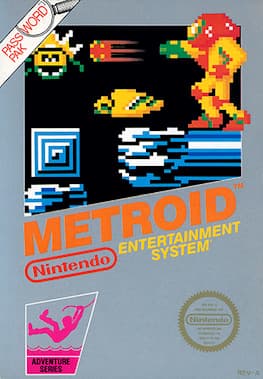
Metroid
| Year | 1986 |
|---|---|
| Release platform | NES |
| Genres | platformer, adventure |
| Developer | Nintendo |
| Country | Japan |
| Era | Eight bit, 1983 to 1991 |
| Importance |
Why it matters
The planet in Metroid is not divided into levels. It is one connected map that you move through up, down and in both directions, and almost every part of it has passages that can't be opened yet. The key is a new ability of the character: the rolled-up form lets you into narrow gaps, bombs break open floors, the high jump reaches ledges. An enemy frozen by the ice beam stops being a threat and becomes a platform you can stand on, meaning the same weapon works both as a weapon and as a tool.
The order of movement is unfamiliar: progress consists of remembering where an obstacle was earlier and coming back to it with a new ability. There is no map in the game, the plan is kept in your head or on paper, and the color coding of the areas, which tells the parts of the planet apart, helps with that. In Japan the game came out on the disk add-on, while the Western release moved to a cartridge without a battery, so saving was replaced with a password: the state of the playthrough is issued as a string of characters that you copy down and type back in. The final screen depends on how quickly the game was completed, and that is where it comes out who was under the suit.
Watch it played
Facts
- The map is a single connected space; there is no division into separate levels.
- An enemy frozen by the ice beam turns into a platform you can climb on.
- The Western release came out on a cartridge without a battery, so the playthrough was continued with a password.
- In Japan the game came out on the disk-based Famicom Disk System.
- There is no built-in map, and the final screen depends on the completion time.