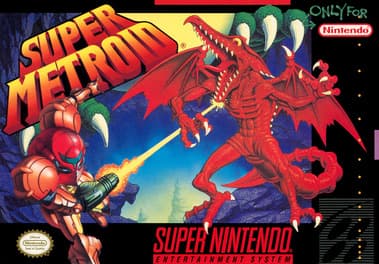
Super Metroid
| Year | 1994 |
|---|---|
| Release platform | SNES |
| Genres | platformer, adventure |
| Developer | Nintendo |
| Country | Japan |
| Era | Sixteen bit, 1989 to 1995 |
| Importance |
Why it matters
Super Metroid builds its planet as a single connected space that you can walk through in both directions. A passage is closed by physical impossibility: a gap can only be passed in ball form, a high ledge can only be reached with the grapple, heat and water each demand their own suit. Every new ability both expands the map and changes the meaning of places already visited, so going back becomes the main way of moving forward.
Separate work went into orientation. There is a map on screen that fills in as you explore and marks elevators and save points, so the huge labyrinth can be held in your head. Almost nothing is said in words: the information about where to go is hidden in the shape of rooms, in animation hints and in the behavior of the local creatures. The final screen shows the completion time and the share of items collected, and the practice of speedrunning later grew on that counter.
Watch it played
Facts
- The map fills in as you explore and shows visited rooms, elevators and save points.
- Items open access to parts of the planet: the ball, bombs, the grapple, suits against heat and water.
- The intro retells the ending of Metroid II with the Metroid larva.
- Beam weapons stack, and several beams work at the same time.
- The final screen shows the completion time and the share of items collected.