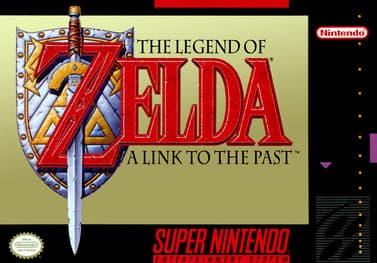
The Legend of Zelda: A Link to the Past
| Year | 1991 |
|---|---|
| Release platform | SNES |
| Genres | adventure |
| Developer | Nintendo |
| Country | Japan |
| Era | Sixteen bit, 1989 to 1995 |
| Importance |
Why it matters
After the side view of the second installment, the series returned to the top-down view, and returned with a rule it still works by today. A dungeon is built as a self-contained problem: an item lies inside, that same item is what solves the dungeon, and outside it opens up parts of the overall map that couldn't be reached before. The hookshot pulls you across a chasm, the hammer drives in stakes, the flippers let you into the water. The world is therefore not divided into levels; it unfolds as the tools are collected.
There are two maps here, and they are laid over each other. The Dark World repeats the outlines of the Light World, but with different terrain and different obstacles, and the mirror doesn't bring you back from just any point. The same place has to be read twice: to get around an obstacle in one world, the player crosses it in the other and goes back. Inside the dungeons a set took hold that many later adopted: a floor map, a compass, a separate key to the master's room. The battery in the cartridge made it possible to make the playthrough long and split into several sessions, and the map big enough that it has to be remembered.
Watch it played
Facts
- Every dungeon gives out the item that solves it, which then opens new parts of the overall map.
- The Dark World repeats the outlines of the Light World, but with different terrain and different obstacles.
- The mirror brings you back from the Dark World to the Light World, and the transition doesn't work from just any point.
- The dungeons hold a floor map, a compass and a separate key to the master's room.
- The series returned to the top-down view after the side view of the second installment.