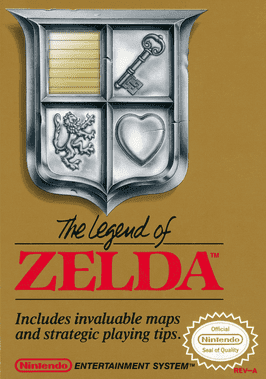
The Legend of Zelda
| Year | 1986 |
|---|---|
| Release platform | NES |
| Genres | adventure, RPG |
| Developer | Nintendo |
| Country | Japan |
| Era | Eight bit, 1983 to 1991 |
| Importance |
Why it matters
The cartridge of the Western release contained a battery and a memory chip, so progress was saved right inside it. A technical detail changed the structure of the whole project: once a game can be interrupted and resumed, the world stops being a sequence of levels and becomes a territory you return to.
The map is open almost from the very start. The order of the dungeons is partly up to the player, some items are mandatory, and some simply make the road easier. Hints are few, and that is a deliberate decision: certain passages open only with a bomb or a burned bush, and nowhere is this said outright, so knowledge was pieced together from the finds of a whole neighborhood or a whole class. After the ending, a second version of the world opens with a different arrangement of dungeons, which doubles the content without new resources. This is also where the techniques that became permanent for the series took shape: an item from a dungeon opens access to the next areas, and progress rests on the character's new abilities.
Watch it played
Facts
- The Western cartridge contained a battery and memory, so progress was saved without a password.
- In Japan the game came out on the disk-based Famicom Disk System.
- After completion a second version of the world opens with a different arrangement of dungeons.
- Some passages open only with a bomb or a burned bush, and there is no hint about it in the game.
- The order in which the dungeons are visited is partly left up to the player.