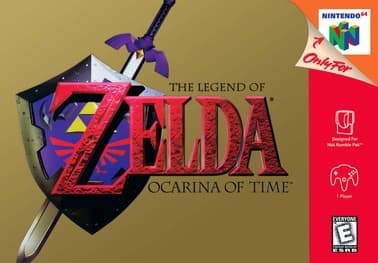
The Legend of Zelda: Ocarina of Time
| Year | 1998 |
|---|---|
| Release platform | N64 |
| Genres | adventure |
| Developer | Nintendo |
| Country | Japan |
| Era | Disc and 3D, 1995 to 2000 |
| Importance |
Why it matters
The move into 3D ran into the problem of aiming. The controller has one analog stick and no separate stick for the camera, and Nintendo solved the problem with target lock: at the press of a button the hero and the camera keep the enemy in focus, tilting the stick becomes a sideways circle around it, and the shield and attacks aim themselves. Combat becomes readable because you can see who is in front of you and where you are in relation to them. After this the technique spread to almost every console adventure game.
One and the same button pushes, lifts, talks and climbs, and its current meaning is labeled right on the screen, so the set of actions grows without the number of buttons growing. The ocarina works as a command language: melodies are entered with the C and A buttons, and each melody unlocks something, moves you across the map, changes the time of day or calls the horse. The world is played through as two ages of the hero, and the same map in two states reads differently, so the space is used twice without doubling the work.
Watch it played
Facts
- Target lock keeps the enemy in focus, and the hero moves sideways around it.
- A single action button changes its purpose with the situation, and its current meaning is labeled on screen.
- Ocarina melodies are entered with the C and A buttons and work as keys and commands.
- A melody calls the horse, which is used to cross the field between areas of the map.
- The same map is played through as two ages of the hero.