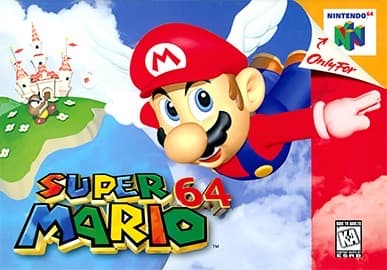
Super Mario 64
| Year | 1996 |
|---|---|
| Release platform | N64 |
| Genres | platformer |
| Developer | Nintendo |
| Country | Japan |
| Era | Disc and 3D, 1995 to 2000 |
| Importance |
Why it matters
The move to three dimensions meant deciding all over again what controlling a character is. The analog stick gives a continuous range: Mario sneaks, walks or runs depending on how far the stick is tilted. Added to this is a set of moves, each with its own entry conditions: a triple jump after a run-up, a long jump from a crouch, a wall kick, a ground pound. Learning this set is the main content of the game.
The camera is handled literally: the filming is done by a separate character on a cloud, and the C buttons rotate him around Mario. The castle works as a hub from which paintings lead into worlds, and each world holds a list of stars with different tasks, from a race to a search. A level isn't played once through to the end: you come back to it with a new goal, and the familiar space reads differently. Both ideas, the free camera and analog movement, were repeated for decades afterward.
Watch it played
Facts
- The analog stick sets the speed smoothly, from a sneaking step to a run.
- The camera is operated by a separate character on a cloud, and the C buttons rotate it around Mario.
- The castle works as a hub: paintings on the walls lead into separate worlds.
- Each world has several stars with different conditions, and the level is replayed for each one.
- The game was released together with the Nintendo 64 console.