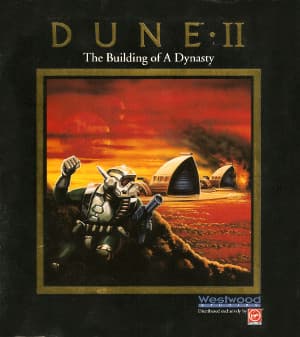
Dune II
| Year | 1992 |
|---|---|
| Release platform | PC |
| Genres | strategy |
| Developer | Westwood Studios |
| Country | USA |
| Era | Sixteen bit, 1989 to 1995 |
| Importance |
Why it matters
Westwood Studios brought together in one program what had existed separately before: resource gathering, base building, unit production and real-time combat. The player moves the mouse over the map and gives orders by pointing directly, without typing commands on the keyboard and without a separate control screen. Harvesters collect the spice, haul it to a refinery and turn it into credits, credits build structures, and structures unlock the next structures and units. This loop became the standard for the genre for a decade to come.
The map is covered by a shroud and opens only where your own troops have been, so scouting stops being a formality. The three houses differ in vehicles and special weapons, so the same map plays out differently. Much is still missing: you can select only one unit at a time, and production queues barely exist. Much of the genre's later history consists of fixing these spots.
Watch it played
Facts
- Orders are given with the mouse right on the map, without typing commands on the keyboard.
- The economy is built around spice: harvesters haul it to the refinery, where it turns into credits.
- The build order forms a tree, and new structures unlock only after the previous ones.
- Only one unit can be selected at a time; you can't gather a group with a drag box.
- House Ordos was invented for the game and does not appear in Frank Herbert's novels.