Resident Evil
| Year | 1996 |
|---|---|
| Release platform | PlayStation |
| Genres | horror |
| Developer | Capcom |
| Country | Japan |
| Era | Disc and 3D, 1995 to 2000 |
| Importance |
Why it matters
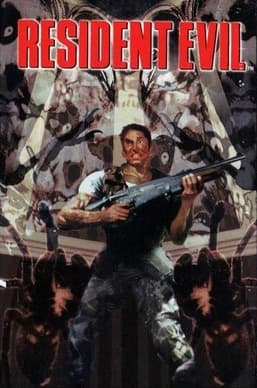
Capcom built its mansion out of pre-drawn pictures: in every room the camera stands in its own spot and does not follow the character. The decision saves the console's resources, because only the characters are computed in real time, and at the same time it sets the rules. Part of a room stays out of frame, footsteps are heard before their source is seen, and the controls are relative to the character, so a change of angle doesn't flip the direction of movement mid-stride.
Scarcity here is built into the design. The inventory is limited to slots, extra items have to be left in a chest, there isn't enough ammunition for every enemy, and saving uses up an ink ribbon for a typewriter, and the mansion holds a finite number of ribbons. So a fight is almost never worth it: it's cheaper to go around, memorize the route and come back later with the right key. Transitions between rooms are covered by an animation of a door opening, which hides the loading from the disc, and the forced pause also works as rhythm. The mansion itself is built as one connected puzzle of locks and locked doors, so keeping its floor plan in your head matters more than shooting straight.
Watch it played
Facts
- Room backgrounds are drawn in advance, and the camera in each room is fixed and does not move.
- The direction of movement is set relative to the character, not relative to the screen.
- The inventory is limited to slots; extra items are left in a chest.
- Every save uses up an ink ribbon for a typewriter.
- The transition between rooms is covered by an animation of a door opening, behind which the disc is being read.