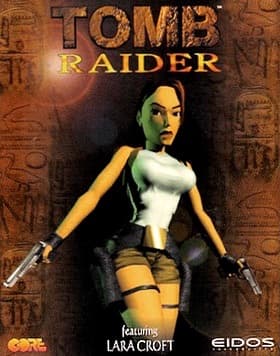
Tomb Raider
| Year | 1996 |
|---|---|
| Release platform | PlayStation |
| Genres | adventure |
| Developer | Core Design |
| Country | United Kingdom |
| Era | Disc and 3D, 1995 to 2000 |
| Importance |
Why it matters
Core Design built its levels out of cubic blocks and made that grid visible in the controls. Lara walks and jumps fixed distances that are multiples of a block, so the distance to a ledge is judged by eye in advance. There is a separate walk button that keeps you from stepping off an edge, and a ledge grab with the hands in mid-jump. The result is a problem of measuring space: where to stand, where to take a run-up, where to jump from. A mistake in the calculation ends in a fall, so you read the level before you jump.
The camera follows the heroine from behind and turns with her, and weapons lock onto a target automatically so that shooting doesn't get in the way of movement. The caves and temples are almost empty: there are few enemies, but plenty of traps, water and heights. The third-person view, a female lead and an advertising campaign built around a single character together set the pattern for releasing console adventure games for years to come.
Watch it played
Facts
- Levels are built from cubic blocks, and jumps are designed for distances that are multiples of a block.
- A separate walk button keeps you from stepping off an edge.
- Weapons aim at a target automatically; the player is responsible for movement.
- The camera follows the heroine in third person and turns with her.
- The game was released on PlayStation, Sega Saturn and PC.